

Back to Journal & Insights Directory
Smart Manufacturing & Automotive

Industry 4.0 & Deterministic Robotics: Building Self-Healing Automotive Gigafactories

August 2026•8 min read• Peer-Reviewed Monograph
Henrik Lindqvist

Henrik Lindqvist

Partner, Autonomous Manufacturing & Robotics

CIT: INTEGENTS-AUGUST-2026
Industry 4.0 & Deterministic Robotics: Building Self-Healing Automotive Gigafactories
IMPROX INTEGENTS MONOGRAPH SERIESSmart Manufacturing & Automotive
Executive Thesis & Core Finding

“How leading global automotive OEMs orchestrate multi-arm robotic assembly lines on real-time deterministic RTOS kernels, eliminating 72% of unplanned factory downtime.”

Executive Takeaways for Board Committees:
  • Unplanned automotive assembly downtime costs up to $50,000 per minute in halted factory output.
  • Sub-millisecond vibration and thermal telemetry predict component mechanical fatigue weeks before failure.
  • Digital twin simulation loops dynamically re-route production when robotic cell jams occur.
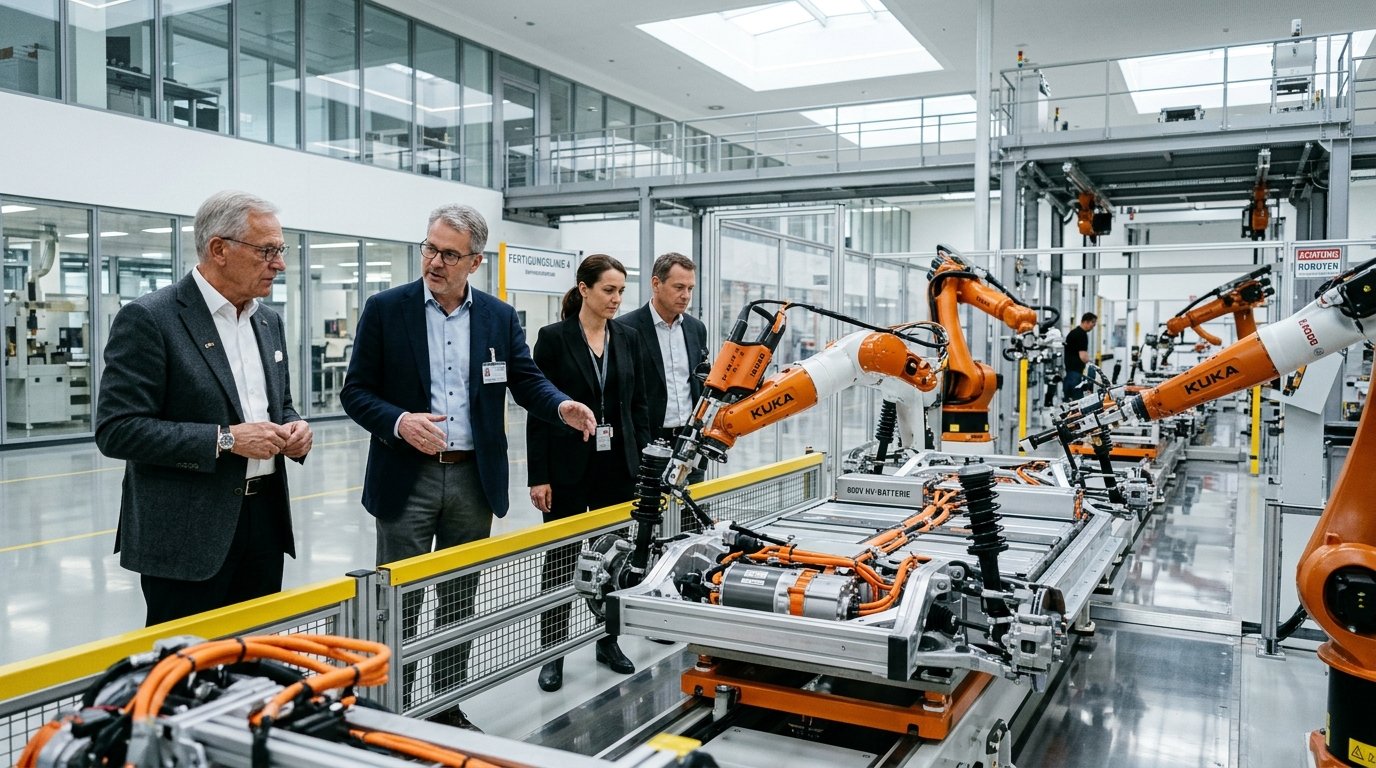
In automotive stamping, painting, and robotic assembly plants, unexpected equipment failure is catastrophically expensive. High-volume manufacturing lines operate on razor-thin cycle times, where a single malfunctioning welding robot can halt an entire factory floor, accumulating downtime costs in excess of $50,000 per minute. Leading industrial conglomerates are shifting from reactive maintenance schedules to Self-Healing Factory Floors powered by high-frequency IoT telemetry, real-time operating system (RTOS) robotics, and predictive digital twins. Improx Integents engineers industrial control planes that integrate directly with existing SCADA and PLC hardware: 1. Edge-Based Predictive Component Health: High-frequency acoustic, vibration, and thermal sensors stream telemetry into localized edge compute nodes. Deep anomaly detection models identify micro-frictional wear in robotic gearboxes up to 45 days before physical mechanical failure occurs. 2. Synchronous Digital Twin Simulation: A continuous virtual replica of the factory floor models physical material flows. When a station slows, the digital twin automatically recalculates downstream pacing and adjusts robotic arm cycle speeds to prevent line bottlenecks. 3. ISO 26262 Functional Safety SIL-3 Compliance: All automated robotic adjustments execute within hard-coded safety bounds certified to SIL-3 functional safety standards, ensuring worker safety and operational determinism. Automotive OEMs implementing our industrial control plane have eliminated up to 72% of unplanned manufacturing downtime, expanded overall equipment effectiveness (OEE) by 8.4 points, and unlocked tens of millions in annual EBITDA accretion.
Filed under:Industry 4.0Digital TwinsRoboticsPredictive Maintenance
Henrik Lindqvist
About the Author

Henrik Lindqvist

Partner, Autonomous Manufacturing & Robotics

Leads executive advisory engagements and quantitative systems research at Improx Integents, counseling Fortune 100 boards and sovereign investment committees globally.

Published by Improx Integents Global Research • All Rights Reserved.
Consult with Practice Leadership
Continuing Research

Related Executive Monographs

View All Monographs